Full-Grain, “Genuine” & Bonded Leather: What “Made to Last” Means

Two pieces of leather can tell very different stories
Pick up a leather belt that has been worn for years. You might see creases, a darker surface around the buckle, and marks from days its owner probably doesn’t remember.
Now picture a belt whose surface has started peeling away, revealing something underneath that looks nothing like the outside.
Both may have been sold with the word “leather” somewhere on the tag. But the materials, construction, and expectations behind them can be very different.
That’s where leather shopping gets confusing. Full-grain, top-grain, genuine, bonded, vegetable-tanned—the terms get mixed together as though they describe one simple ladder from best to worst.
They don’t. Some describe the hide’s surface, some describe how it was processed, and others tell you very little without more explanation.
At Busted B Leather, we’d rather explain what we use and why than ask you to trust an impressive-sounding label.
What full-grain actually tells you
Full-grain leather retains the hide’s natural grain surface without sanding it away to remove imperfections.
That surface can show natural markings and variations. Those details are part of working with a hide rather than a manufactured sheet with a perfectly repeated pattern.
For a leatherworker, it means choosing where each part comes from. A side still needs inspection, and the placement of a holster front, belt, or sheath matters.
Full-grain is a useful description, but it isn’t a complete guarantee of quality. The original hide, tanning, thickness, finish, and construction all influence how the finished product performs.
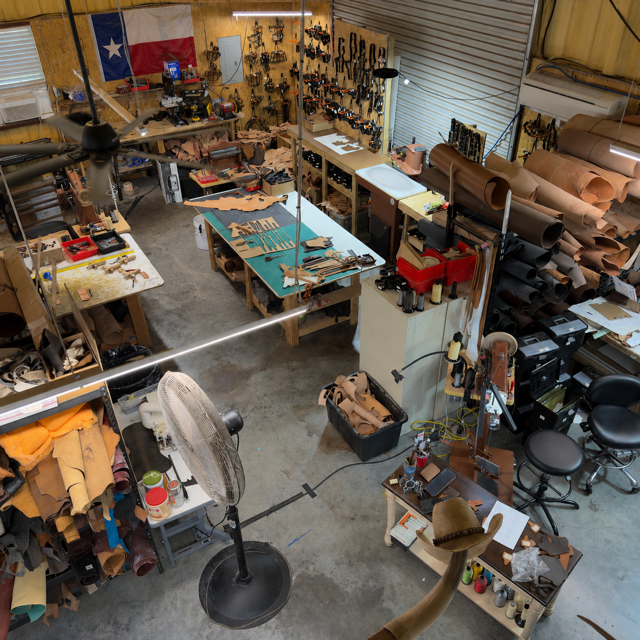
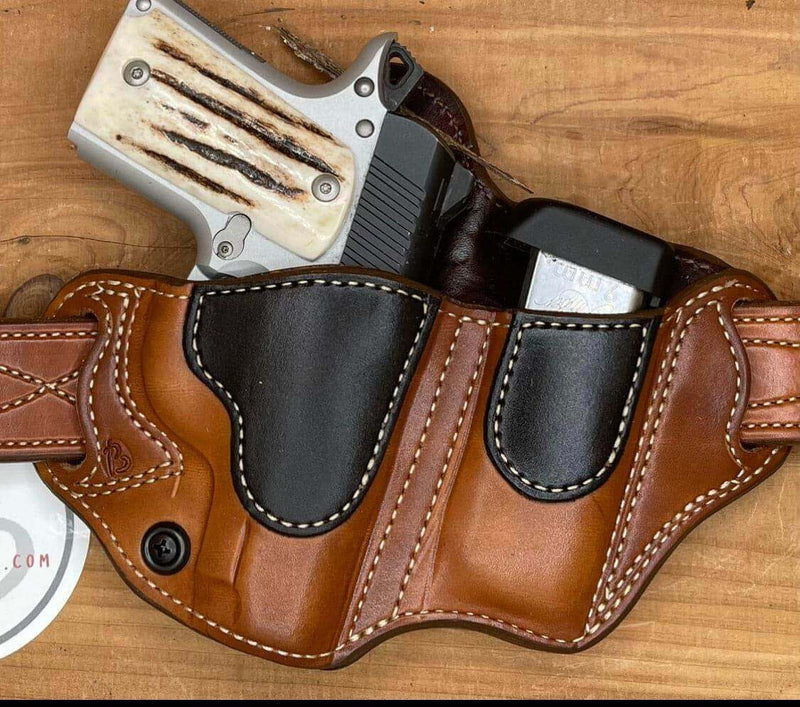
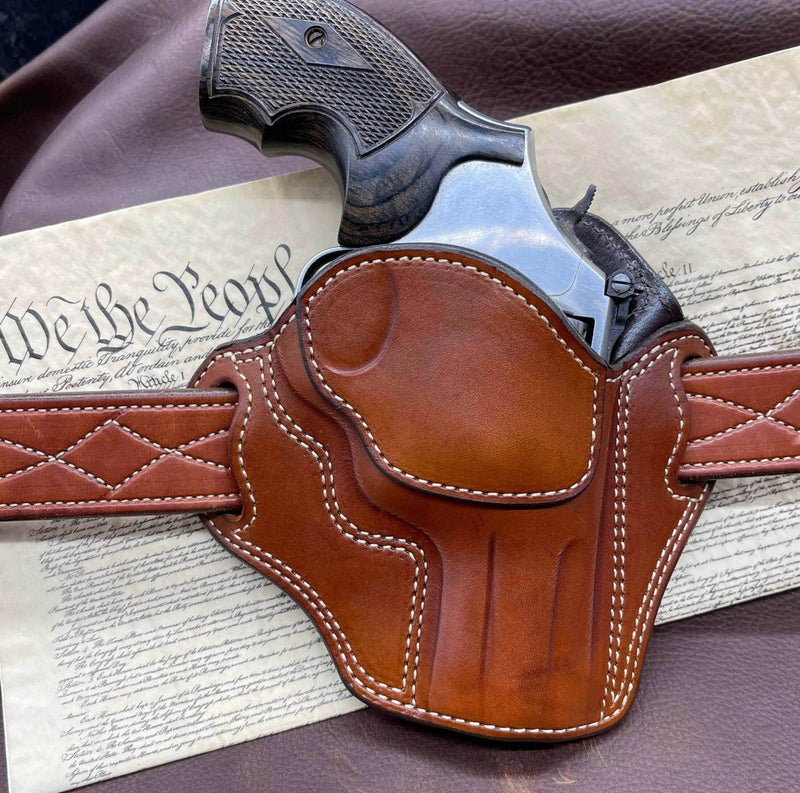
In our shop, full-grain Hermann Oak cowhide gives us the material we want for holsters, belts, and sheaths. What happens at the bench turns that material into working gear.
Where top-grain fits in
Top-grain refers to leather from the grain-bearing upper portion of the hide. Full-grain belongs within that broader category, although retail descriptions often use “top-grain” to mean leather whose surface has been sanded or corrected.
That correction can create a more uniform appearance. It doesn’t automatically make the leather poor.
A carefully made product using corrected-grain leather may serve its purpose well. The useful questions are how the leather was processed, how heavily it was coated, and whether its properties suit the job.
A soft bag and a molded holster need different things from their materials. Judging both by a single label misses that distinction.
“Genuine leather” needs a follow-up question
“Genuine leather” isn’t a universal quality grade sitting just above bonded leather.
The words alone don’t tell you whether the material is full-grain, corrected-grain, or split leather. They don’t identify the tanning method or explain the construction of the finished piece.
That means you shouldn’t assume the phrase promises premium quality. You also shouldn’t assume it proves the leather is bad.
We offer Genuine Water Buffalo on select products. In that name, “genuine” identifies real Water Buffalo leather. It isn’t shorthand for a lower layer of cowhide or a position on a grading chart.
If a listing gives you nothing beyond “genuine leather,” ask for more information. What hide is it? How was it tanned? Why was it chosen for that product?
A maker who knows the material should be able to explain it.
Bonded leather is a different construction
Bonded leather is made by combining leather fibers or particles with a binder to form a composite material. It may also have a backing and a coated surface that gives it a leather-like appearance.
That is fundamentally different from a continuous piece of hide.
Its performance depends on the formulation, backing, coating, and use. You can’t assign every bonded product the same expiration date, but you also shouldn’t expect it to behave like a substantial piece of full-grain leather.
For our working holsters, belts, and sheaths, bonded leather isn’t the material we choose. We want the structure of the hide itself, selected in the thickness and form appropriate to the build.
Tanning answers another question
Once you understand the surface and construction, tanning adds another part of the story.
Tanning stabilizes a hide and turns it into usable leather. Vegetable tanning uses plant-derived tannins, while chrome tanning uses chromium salts. Neither term identifies whether the leather is full-grain.
The vegetable-tanned Hermann Oak cowhide we use works well for our molded holsters and sheaths. It can be dampened, formed, and worked into the shape the design requires. Smooth Hermann Oak also takes decorative stamping.
Chrome-tanned leather can be durable and well suited to many products, including footwear, garments, and bags. It isn’t automatically cheap or unsuitable for every kind of working gear. The finished leather’s properties matter more than treating one tanning method as universally good and another as bad.
Our Genuine Water Buffalo options have their own grain, texture, and working characteristics. Water Buffalo is not Hermann Oak cowhide, and it cannot be stamped. Decorative stamps are available only on smooth Hermann Oak leather.
The right material depends on what we’re building and the options offered for that piece.
Why we name Hermann Oak
Hermann Oak has been making vegetable-tanned leather in St. Louis since 1881.
That history is part of its appeal, but what matters at our bench is how the leather works. We need to cut it cleanly, assemble it accurately, form it where the design calls for molding, and finish the edges properly.
Naming the tannery gives you something specific to understand about our material choice. It also lets us explain why that leather suits the product.
We still inspect every side. A respected tannery doesn’t eliminate natural variation or replace the judgment needed to lay out the parts.
Good leather gives us a strong starting point. It doesn’t do the work for us.
“Made to last” has to include the workmanship
A full-grain label can’t secure a poorly finished seam or correct a pattern that doesn’t fit.
Longevity depends on the whole piece: suitable leather, sound construction, secure attachments, finished edges, and care appropriate to its use.
For a holster, that includes matching the supported firearm and maintaining the structure needed for secure carry. For a belt, it includes supporting weight without the construction failing. For a sheath, it means holding the intended knife properly and remaining securely attached.
Good leather will develop marks and character. That’s different from damage that affects its function.
No material makes gear indestructible. Inspect what you carry, follow the care guidance, and ask for help when something changes. Our leather care guide explains routine cleaning, drying, and storage.
We stand behind manufacturer defects for as long as you own the piece, unless it has been altered.
Buy the piece, not just the promise
When you compare leather goods, look for an explanation rather than a string of flattering words.
What leather is being used? Why does it suit the job? Can you see the lining, seams, edges, and attachment points? Does the maker explain fit and care?
Price belongs in the decision, but it won’t answer those questions by itself. An inexpensive product isn’t automatically bonded leather, and an expensive one still needs workmanship that justifies its price.
Around here, our business card says, “Cool Shit Ain’t Cheap & Cheap Shit Ain’t Cool.” The leather matters. So does the time spent turning it into something worth carrying.
Explore our in-stock leather gear for finished pieces that ship within 3–5 business days, or browse our made-to-order collection to see the available builds and options. Check each listing for materials, compatibility, and current lead time.
“Made to last” should mean more than words on a tag. It should show up in the material, the construction, and the service behind the piece.
Leave a comment